You've got two solar quotes on the kitchen bench. Same system size, different panel brands, and a gap in price that's hard to explain. So are all solar panels the same?
Not quite. The types of solar panels on the market today look almost identical on a roof, but they're built differently inside. Those differences decide how much power you make on a 40-degree Rockingham afternoon, and how long the panels keep working.
Here's a plain-English guide to panel types, what "Tier 1" really means, and the question we hear most: how long do solar panels last?
The Main Types of Solar Panels You'll Be Quoted
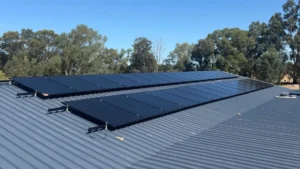
Almost every home system in WA now uses monocrystalline panels. They're made from a single, pure silicon crystal, which gives them the dark, even black look most people picture. Older blue-speckled polycrystalline panels have largely disappeared from home quotes.
The real difference today is the cell technology inside the panel. You'll usually see one of these on a quote or datasheet:
- P-type PERC: the workhorse of the last decade. Reliable and cheaper, but it loses a little more power in heat and over time.
- N-type TOPCon: now the most common choice for new home systems. It generally handles heat better and ages more slowly.
- N-type HJT (heterojunction): a premium cell type with excellent heat performance. Often used in larger commercial panels.
You don't need to remember the acronyms. The simple takeaway is that "n-type" panels are the newer, longer-lasting option, and they suit our hot WA summers well.
What Does "Tier 1" Actually Mean?
"Tier 1" is one of the most misunderstood phrases in solar. Many people assume it's a quality rating. It isn't.
The Tier 1 list is published each quarter by BloombergNEF, a financial research firm. A manufacturer makes the list when banks have financed large solar projects using its panels. In short, it's a measure of financial stability, not panel quality.
That still matters to you as a homeowner. A financially solid manufacturer is more likely to be around in 20 years to honour your warranty. But Tier 1 alone doesn't tell you:
- How efficient the panel is
- How well it copes with heat
- How long the warranty is, or what it covers
- Whether the manufacturer has a local office in Australia
There's also a more important list for Australian homes. The federal solar rebate is paid through small-scale technology certificates (STCs). To qualify, panels must be on the Clean Energy Council's approved products list. From 1 May 2026, new panel models must meet the latest safety standard to be added. Any good installer checks this for you, but it's worth asking.
How Long Do Solar Panels Last?
A quality panel should keep producing power for 25 to 30 years or more. It doesn't suddenly stop. Instead, it slowly makes a little less power each year. This is called degradation.
Look for two separate warranties on any panel:
- Product warranty: covers faults in the panel itself. This ranges from about 12 years on budget models to 25 years on premium ones.
- Performance warranty: guarantees how much power the panel will still make. Many current n-type panels promise around 87% of their original output after 30 years.
For example, Trina's Vertex S+ panels are rated to lose 1% in year one. After that, it's 0.4% a year. Risen's n-type rooftop panels guarantee at least 87.4% output after 30 years. Always check the datasheet for the exact model on your quote, as warranties vary between models from the same brand.
Why Heat and Salt Air Matter in Rockingham
Solar panels love sunshine but don't love heat. On a hot day, panels on a dark roof can run far hotter than the air around them. The hotter they get, the less power they make.
Each panel has a "temperature coefficient" on its datasheet. It tells you how much power it loses for every degree above 25°C. Around -0.3% per degree or lower is a good figure. Many n-type panels sit at about -0.25% to -0.30%.
Then there's the coast. Homes in Safety Bay, Shoalwater, Secret Harbour and Waikiki cop salty sea breezes most afternoons. Salt can corrode frames, mounting rails and connectors over time. Ask whether your panels are tested for salt mist corrosion. Look for "IEC 61701" on the datasheet. Make sure the installer uses quality rails and fixings too.
Risen, Jinko and Trina: Three Brands We Trust
At COYCO we install panels from three established manufacturers. Each has a long track record in Australia and offers n-type panels for home systems.
- Risen Energy solar panels: strong heat performance and long performance guarantees on their n-type range.
- Jinkosolar panels: one of the world's biggest panel makers, with the popular Tiger Neo n-type series.
- TrinaSolar panels: the Vertex S+ uses glass on both sides instead of a plastic back sheet, which adds durability.
There's no single "best" panel for every home. The right choice depends on your roof, your budget, your power use and how close you live to the beach.
A Local Example: Comparing Two Quotes in Baldivis
Picture a family in a 10-year-old Baldivis home comparing two 6.6kW quotes. Quote A is cheaper, using older p-type panels with a 12-year product warranty. Quote B costs more, using n-type panels with a 25-year product warranty and a 30-year performance warranty.
On day one, both systems produce similar power. Over 25 years, Quote B's panels lose less output each year and handle summer heat better. The family is also covered for much longer if a panel fails. For many households, that peace of mind is worth the difference.
Not sure what size system you need first? Our guide to choosing the right size solar system in Perth is a good place to start.
Questions to Ask Before Choosing Solar Panels in Rockingham
Before you sign a quote, ask your installer:
- What brand and exact model are the panels? Can I see the datasheet?
- Are they n-type or p-type?
- What are the product and performance warranties, and who handles claims in Australia?
- Are they on the Clean Energy Council approved list?
- What's the temperature coefficient?
- Are they rated for salt mist, and what rails and fixings will you use?
A good installer will answer all of these without fuss. For more tips, read our guide on how to choose a solar installer in Perth.
Frequently Asked Questions
Are all solar panels the same?
No. Most look alike, but the cell technology, heat performance, warranty and build quality vary a lot. Newer n-type panels generally age more slowly and cope better with heat than older p-type panels.
What are the main types of solar panels?
Home systems now almost all use monocrystalline panels. Inside those, the main cell types are p-type PERC, n-type TOPCon and n-type HJT. N-type is now the most common choice for new installs.
Is a Tier 1 solar panel better quality?
Not necessarily. Tier 1 is a BloombergNEF list based on a manufacturer's financial standing, not a quality test. It's a good sign the company will be around to honour your warranty. Check the panel's specs and warranty too.
How long do solar panels last in WA?
A quality panel should last 25 to 30 years or more. Many current n-type panels guarantee around 87% of their original output after 30 years. Heat and salt air can shorten the life of cheaper components, so quality matters near the coast.
How much do solar panels cost in Rockingham?
It depends on the panel brand, system size and your roof. Please contact the office for a quote with upfront pricing for your home.
Get Honest Advice on Solar Panels in Rockingham
Choosing solar panels is a 25-year decision, so it pays to get it right. As your local energy efficiency experts, the COYCO team can help. We'll talk you through the panels that suit your roof, budget and power use.
Thinking about adding storage too? See how solar batteries can help you use more of your own sunshine. You can also explore our range of solar panels and solar power options in Rockingham. Or pop into our Rockingham showroom for a chat.
Chat with the team today for honest advice and a no-obligation quote.