Are You Getting The Best Return with your Solar Feed-in Tariffs in WA?
If you have solar installed on your home, you’ve probably asked: Are my solar feed-in tariffs in WA actually giving me a good return?
With tariff structures changing over recent years and electricity prices continuing to rise, many Western Australian homeowners are unsure whether exporting solar energy is still worthwhile — or if there’s a smarter way to maximise value from their system.
This guide explains how solar feed-in tariffs WA work in 2026, what you’re likely earning, and how to ensure you’re getting the best return possible.
What Are Solar Feed-in Tariffs?
Solar feed-in tariffs (FiTs) are payments you receive from your electricity retailer for exporting excess solar energy back to the grid.
When your solar panels produce more electricity than your household is using, the surplus energy flows back into the network. Your retailer credits you for that exported power.
However, in WA, feed-in tariffs are significantly lower than they were a decade ago — which has changed how homeowners should think about solar returns.
How Solar Feed-in Tariffs Work in WA
Western Australia operates differently from eastern states because of its isolated electricity grid. Retail pricing structures and buy-back rates are determined locally.
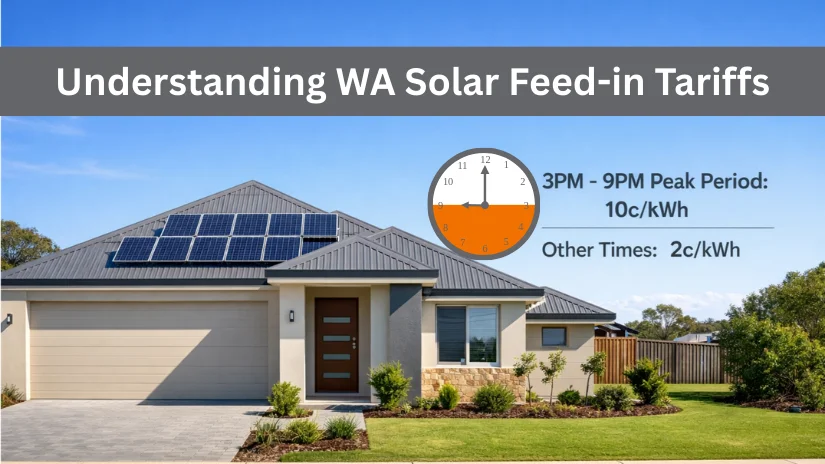
Under current arrangements, most households eligible under the Distributed Energy Buyback Scheme (DEBS ) receive:
- A daytime export rate (lower value)
- A higher late afternoon/early evening export rate under certain plans
The exact rate depends on your retailer and whether you’re on a time-of-use plan.
While export payments still contribute to savings, they are no longer the primary way solar delivers value.
The Key Shift: Self-Consumption Matters More
Years ago, high feed-in tariffs meant exporting power could significantly reduce bills. Today, the financial benefit of solar in WA largely depends on how much energy you use during the day.
In simple terms:
- Using your own solar energy saves you the full retail electricity rate.
- Exporting it earns you a lower buy-back rate.
This is why modern solar advice focuses heavily on increasing self-consumption rather than maximising exports.
Are You Getting the Best Return From Your Solar?
To determine whether your solar system is delivering strong value, consider these factors:
1. How Much Energy Are You Using During Solar Hours?
Homes where occupants are out all day may export most of their generation. That reduces potential savings.
Shifting usage to daylight hours — such as running dishwashers, washing machines, pool pumps, or charging electric vehicles — can dramatically improve returns.
2. Are You on the Right Electricity Plan?
Different retailers structure solar feed-in tariffs differently. Some offer higher evening export rates, while others provide flat rates.
Reviewing your plan every year ensures you’re not missing out on a better option.
3. Is Your System Sized Correctly?
Oversized systems may export excessive energy for low returns. Undersized systems may not offset enough grid usage.
Correct system design tailored to household usage patterns is essential.
A WA Example: Coastal Suburb Household
Consider a four-person household in Rockingham with a 6.6kW solar system.
Initially, most daytime generation was exported because the family worked standard business hours.
After reviewing their usage patterns and adjusting:
- Pool pump timers were moved to midday
- Dishwasher cycles shifted to afternoon
- Air conditioning pre-cooled the home before peak evening demand
As a result, self-consumption increased significantly, reducing grid reliance and improving annual savings without changing the system itself.
The lesson? Solar performance isn’t just about feed-in tariffs — it’s about how you use the power you generate.
Should You Consider a Solar Battery?
With lower solar feed-in tariffs WA households often ask whether solar batteries are now necessary.
Batteries allow you to:
- Store excess daytime solar energy
- Use stored energy in the evening
- Reduce grid imports during peak pricing periods
While battery technology continues to improve, the decision should be based on usage patterns, long-term plans, and budget, not just tariff rates alone.
For many homes, improving daytime usage habits delivers strong results without immediately investing in storage.
Future Trends in WA Solar Tariffs
Energy policy discussions continue across Australia, including Western Australia. While no one can predict future tariff structures with certainty, long-term trends suggest:
- Continued focus on grid stability
- Incentives for smart energy management
- Greater emphasis on battery and load shifting technology
This reinforces the importance of designing solar systems that prioritise self-consumption.
Common Questions About Solar Feed-in Tariffs WA
Are feed-in tariffs likely to increase again?
There’s no clear indication of significant increases in the near future.
Can I switch retailers to get a better rate?
Possibly. Plan comparisons can reveal different structures and incentives.
Does exporting more always mean higher savings?
Not necessarily. Using solar energy within your home typically provides greater financial benefit than exporting it.
The Bigger Picture: Is Solar Still Worth It?
Absolutely.
Even with lower solar feed-in tariffs in WA, solar remains a strong investment because the real value comes from reducing electricity purchases — not relying solely on export payments.
When properly installed and used strategically, solar power offers:
- Long-term bill reduction
- Protection against rising electricity prices
- Improved energy independence
- Increased property appeal
Feed-in tariffs are simply one piece of the equation.
Final Thoughts: Are You Maximising Your Solar Return?
If you haven’t reviewed your energy plan or usage habits in the past year, you could be missing out on savings.
Understanding how solar feed-in tariffs WA operate, and how your home interacts with them, is key to ensuring you’re getting the best possible return from your investment.
A professional solar assessment from COYCO; the Solar Power Experts in Rockingham can help you optimise system size, usage strategy, and electrical setup to ensure your home is operating efficiently.