
Rockingham EV Chargers: Your Guide
As more Western Australians consider switching to electric vehicles, one of the first questions that comes up is how charging will work at home. Unlike traditional cars, EVs rely on your home’s electrical system. This means understanding charger options, installation requirements, and charging times is essential before making the move. For many first-time EV buyers in Rockingham or Baldivis, this can feel unfamiliar. However, home EV charging doesn't have to be complicated when you have the right local experts.
The Rapid Rise of Electric Vehicles in Western Australia
The shift toward electric transport in WA is no longer a future prediction—it is happening right now. According to recent data from the Department of Transport, the number of licensed EVs in WA has skyrocketed over the last few years. In December 2020, there were fewer than 1500 electric vehicles on our roads. By the end of 2025, that number has surged to nearly 47 000. This represents a massive increase in demand for reliable home ev charging solutions across the southern suburbs.
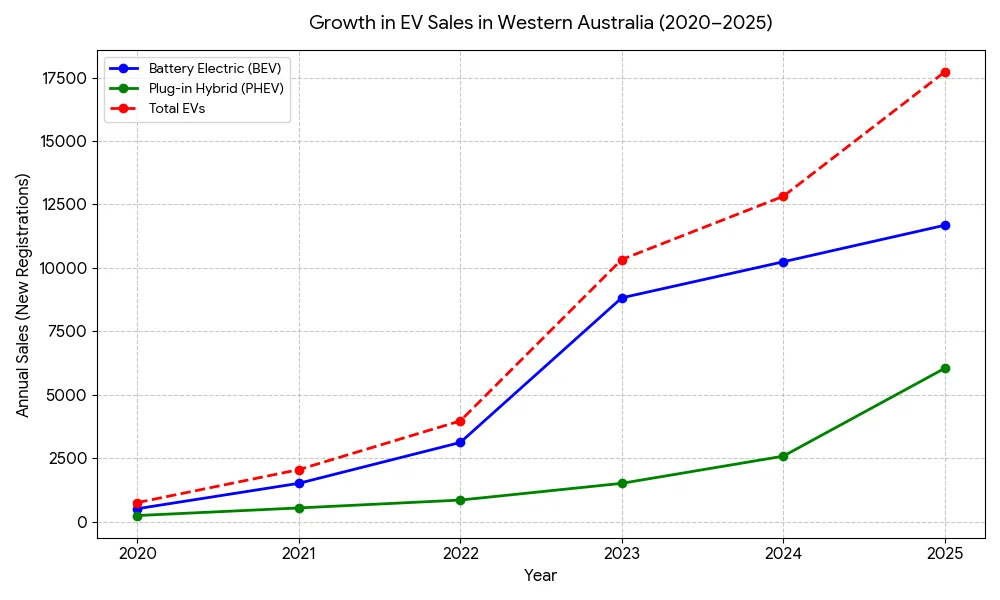
The graph above shows the exponential growth of Battery Electric Vehicles (BEV) and Plug-in Hybrids (PHEV) in WA from 2020 to 2025.
(Western Australian Department of Transport and Electric Vehicle Council (EVC)).
Can You Set Up Home EV Charging in WA?
The short answer is yes! Most residential homes in areas like Warnbro, Port Kennedy, and Secret Harbour are suitable for a home charger. However, it is not as simple as plugging a high-powered charger into a standard power point! A professional home EV charging setup requires a "dedicated circuit." This is a specific electrical line that runs directly from your switchboard to the charger. It ensures that your car can draw the necessary power without overloading the rest of your home's appliances. For more information read our detailed guide on EV Charger Installation.
Understanding Your Home’s Electrical Capacity
Before we begin an installation, COYCO technicians perform a thorough assessment of your "switchboard capacity." This term refers to the maximum amount of electricity your home's main board can handle at one time. If you have an older home in Safety Bay, your switchboard might need an upgrade to support the high demand of home EV charging. We also check for "load balancing" options. This technology allows the charger to adjust its power draw based on what else is running in your house, preventing tripped breakers.
Case Study: Solar-Powered Charging in Baldivis
One of the most exciting benefits of owning an EV in sunny Western Australia is the ability to "charge for free." We recently worked with a family in Baldivis who had an existing 6.6kW solar system. By choosing a smart home EV charging setup, they were able to sync their car's charging schedule with their solar production.
"COYCO showed us how to use our solar excess to charge the car during the day. Now, we rarely pay for 'fuel' because the sun does all the work for us. It’s a complete game-changer for our weekly budget."
For homeowners in Mandurah or Rockingham, integrating solar with your EV charger is the ultimate way to future-proof your home. You can read more about our solar power solutions to see how this could work for you.
How Long Does Charging Typically Take?
Charging times vary depending on the type of charger you use and the size of your car’s battery.
- Standard Power Point (10A): This is the slowest option and can take over 24 hours for a full charge. Best for light, occasional use.
- Home EV Charger (7kW AC): The most common home EV charging setup in Australia. Typically charges a car from empty to full in 6 to 10 hours—ideal for overnight charging.
- Public DC Fast Chargers: Found at shopping centres and along highways. These can charge most EVs to around 80% in 20–60 minutes, but they’re not suitable for home installation.
Some homes with three-phase power can install faster chargers (11–22kW), which can significantly reduce charging times.
Common Questions About Home EV Charging in WA
We hear many questions at our new Rockingham shop regarding EV setups. Here are the most frequent:
- Do I need a three-phase power supply? While not strictly necessary, three-phase power allows for much faster charging. Most WA homes have single-phase, which is still perfectly fine for overnight charging.
- How much does installation cost? Costs vary based on the distance from your switchboard and whether you need a board upgrade. We recommend getting a custom quote for accuracy.
- Can I install the charger myself? No. In WA, all home EV charging work must be performed by a licensed electrician to ensure safety and compliance with Australian standards. COYCO is your local licenced electrician who can undertake this work.
- Will an EV charger increase my property value? Yes! As EVs become the standard, having a pre-installed home charger is a highly attractive feature for future buyers.
Future-Proofing Your Rockingham Home
When you choose COYCO for your home EV charging needs, we don't just look at what you need today. We look at what you might need in five years. This might include installing a larger cable than necessary or ensuring your switchboard has space for a second charger. Whether you are in a coastal property in Shoalwater or a modern home in Baldivis, we ensure your setup is safe, efficient, and ready for the future of transport.
Book Your COYCO Home EV Charging Service Today
Ready to make the switch to cleaner, cheaper driving? The team at COYCO is here to guide you through every step of the process. We work with all major vehicle brands and can recommend the best charger for your specific needs and budget. Our family-owned business is committed to providing the highest quality service to our local community.
Ready to get started?
Visit the COYCO team at our Rockingham shop at Unit 2/5 Leach Crescent, or call us on (08) 9525 0562 to discuss your needs. You can also request a free quote online through our website. Let COYCO help you power your journey with a professional home EV charging setup!